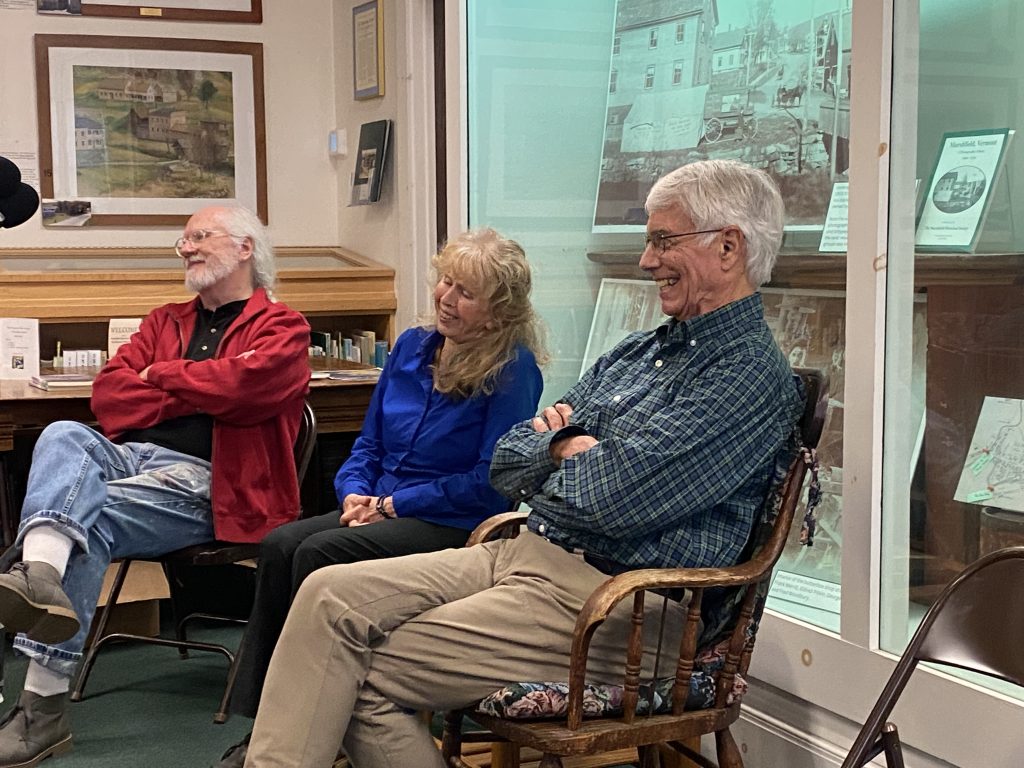
Q:What happens when you put 3 well-grounded artists in a library for an afternoon?
On October 19 during the afternoon, a packed room walked around the painted dirt exhibit on cotton to look at Frederick Rudi’s first public showing of his artwork in 13 years. Rudi spent his childhood in Iowa. Like his favorite poet, Ted Kooser, life in the Plains was direct and simple.
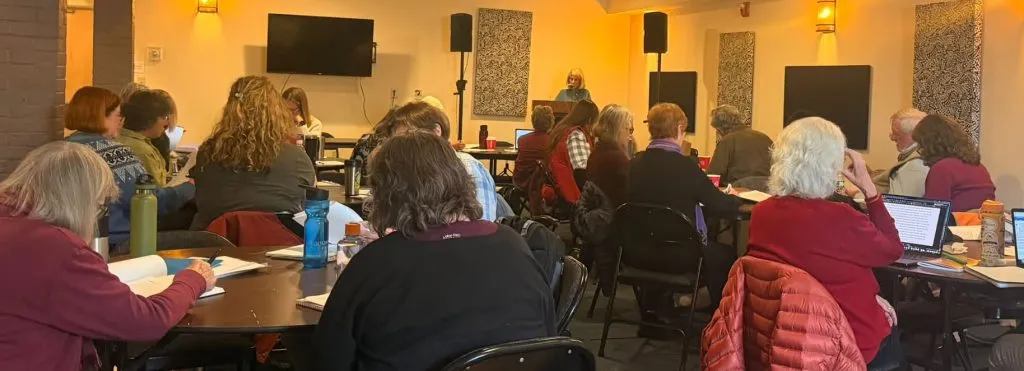
On October 18, 2026–the same day as NoKings4, when nationally, folks were reminding us all to vote–30 poets met for the PSOV’s 2026 Fall Workshop at the Catamount Arts Center in the Northeast Kingdom. They came to learn ways to improve their poetic voices through prompts and rewrites. Betsy Sholl, former Maine Poet Laureate, led the way. Poets shared their rough drafts with others outloud. We reveled in different and parallel themes that the prompts evoked.
Carol Johnson Collins stood at the podium to eulogize Ann Day, a fellow poet and friend spanning 51 years. Carol read Ann’s poem, “Shooting Stars.” (Read more about Ann in this week’s posting:Remembering Ann Day.)
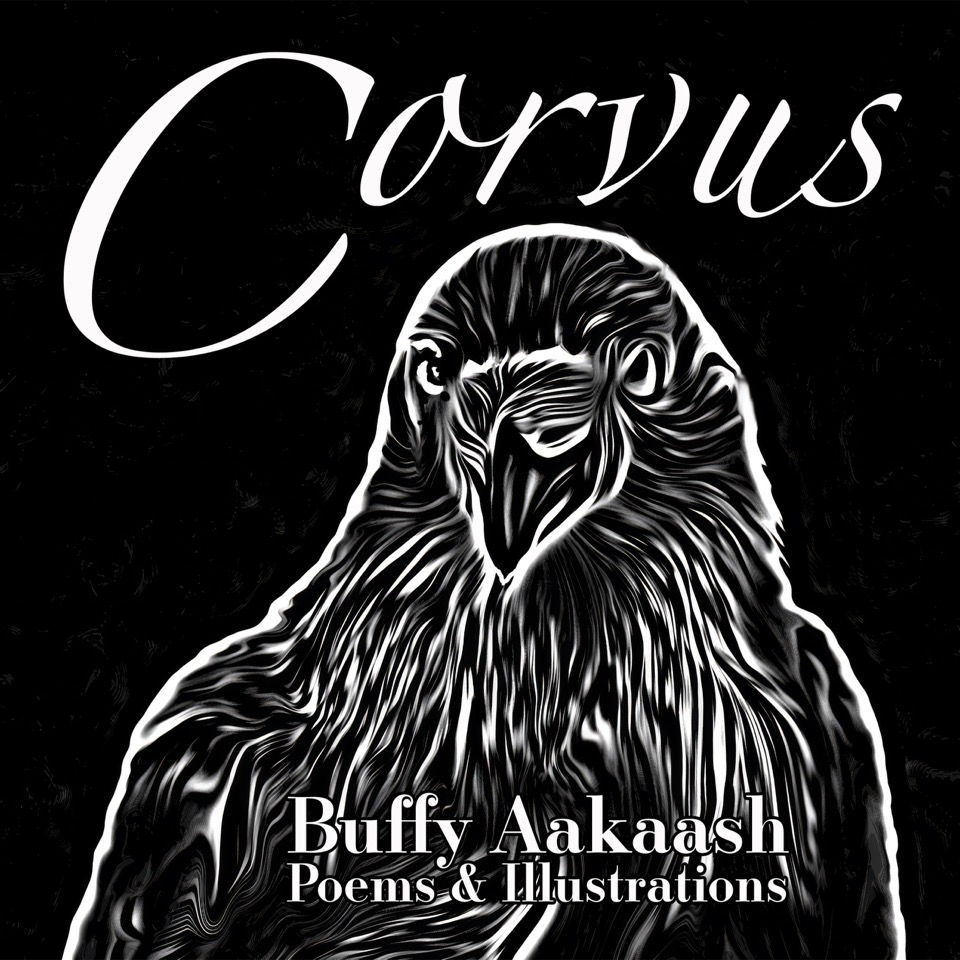
What I wish to share with you is how Corvus–Buffy’s newest publication– represents a unique approach to publishing. Then, I will tell you some other unique features of this book.
Many of us know that the publishing industry has changed in recent years–from wining and dining writers to having them do the heavy lifting. As a result, poets have chosen alternate routes–from printing broadsheets for local distribution to chapbooks paid for by individual authors with presses helping to put them in bookstores.
Corvus signals another departure from business as usual. Instead of waiting for a major publisher to find him or to pay an alternative press to crank out his book, Buffy has taken a different path. His approach might be called publication by subscription. By producing a small number of books–100 in this case–he is relying on 25 subscribers to cover the cost of production. Anything above that goes directly to him. There is no middle man. There is no Amazon.
While scrolling through the book and reading the poems out loud, other unique features became obvious. Twenty-seven poems were included in Corvus. Interspersed throughout the book are also 23 woodcut scenes of crows. Some alone. Some in pairs. Others bunched in trees. The artwork as well as the written work was done by Buffy. As was the page design.
Oh not again the corvid comes
Tells me to get over myself
Your world passes you by
with your eyes wide
(“Eyes Wide as Crows Fly” p.9)
For additional information about this amazing book, go to:
There's flowers now on Linn Street
And the new moon just above
They tore down all the houses
Where we used to make love
But, they'd been long abandoned
When we went there, anyway
And I can still smell the lilacs
In the corner of The Dream Cafe.

(Dream Cafe by Greg Brown)
Some days, I walk out into the world and it is not already made up. There is a protean quality about the day.
Take last Friday, for instance, when I thought that I would check out “Lunch with the Poets” at the Innovation Cafe on Lakeside Avenue in Burlington.
At a time when rumors fly about Canadian fires and, yet again, tariffs are tossed at our neighbors to the north, a gathering of poets took place at the Haskell Library on July 24. Jean-Blaise Bourque shared the podium with Sharon Darrow. Jean-Blaise began with a bilingual introduction, alternating between French and English. He spoke about the community around Derby Line, where family and friends overlapped the arbitrary boundary set by two countries. In fact, the Haskell Library was first built in 1901 to serve neighbors from both sides of that line.
Sharon Darrow, the editor and initiator of The Country in the Mirror (Rootstock Publishing, April 21, 2026), had invited poets who contributed to the anthology to read their poems. The book was an intentional labor of love during these dark times in which we live. Some poets also shared the poems of other contributors who could not attend. We found ourselves in the sanctuary of mutual trust, respect, and defiance to inhumane and incomprehensible acts of our current political regime state-side. The overall feelings that the readings evoked were of solidarity along the lines that count: reaching toward mutual respect and that ever-elusive goal of justice and peace that most people strive toward.
“One old man, well he treat me kind
The old man had a heart of yellow pine
We never know no easy, never got no where
Just the end of a saw
and the cry of a logger’s prayer
To get home tonight…”*
It was a celebration of poetry and how verse can revisit and rebuild a renewal of the best possible world in which to share our resources. If anyone doubts the power of exorcism of evils through both individual and collective poetic discourse, the gathering of poets at the Haskell Library, the proof was evident at the shared readings.
Cindy Ellen Hill has just finished a gothic epic, Leeds Point: a Gothic Novel in Verse,cloaked in both history and narrative power. Its 300 + pages is staggering because it is rendered in verse. This is not surprising. Cindy Ellen Hill’s background lends itself to poetry, for she is an accomplished singer and musician. Remember: there was a time when poetry shared with others was sung in villages or courtyards.
After listening to D. Avery read at Jaquith, I thought I would dive into two of her chapbooks. And I was not disappointed. Chicken Shift (Exeter Press, 2013, Third Printing) and For the Girls (Exeter Press 2016, First Edition) were surprisingly different in theme and mood.
Those of us at the Jaquith Public Library on June 21st were treated to a rich medley of poetic forms and topics shared by D. Avery and Cindy Ellen Hill. We were also given insight by two different poets as to what moved them to write poems.