Audience: PSOV Members new to submitting. (Free to members (join to attend!); registration required.)
Description: Nobody will publish that poem if you don’t submit it. This workshop will provide tips for organizing your submissions and finding suitable places to submit. It is not a revision session; for that try our monthly online poetry group in addition to this one.
The Milk House has nominated my poem, “Grieving Horses,” for the Best of the Net Anthology. With gratitude to Editor Ryan Dennis for this unexpected honor. ~ Julia H. Fonte.
—we still have seats available for our 2026 Fall Workshop on Saturday, October 17th!
Whether you’re a long-time member or completely new to our community, everyone is welcome. Free for PSOV members but you don’t need to be a member to attend—non-members can drop in and pay $25 at the door (cash or check).
(Tip: Consider becoming a PSOV member for just$15 more! Membership is $40/year and includes free admission to all online and in-person workshops, free submissions to our Spring, Fall, Summer, and Troubadour contests, and an annual copy of The Mountain Troubadour.)
October 28th, 6:30pm to 8:00pm Online Google Meeting
Join Middlebury poet Cindy Ellen Hill, author of the gothic horror novel in sonnet verse Leeds Point, to explore poems for the Halloween season–if you dare! Cindy will read from classic and contemporary horror poetry and we’ll discuss what poetical elements and techniques are effective in invoking goosebumps in readers. Participants should also bring eerie poems — your own or ones you love by other poets–to share and talk about. Pour yourself a hot cider and bring some friends for a fun literary fright night!
Poets use diction and syntax as the core tools to write a poem, like a builder uses tools create a structure. However, if a poem is a building made of words, just as a builder needs more than only a hammer and nails, many other writing tools, like rhythm and meter, must be added to the tool kit. A poem’s lines, like beams in a building, don’t hover in the air. They rest on posts of some sort, reinforced in a foundation, consisting partly of the “theme.” A poem could be built even on a single word, as long as the posts and beams that hold up that word are strong. ~ Buffy Aakaash
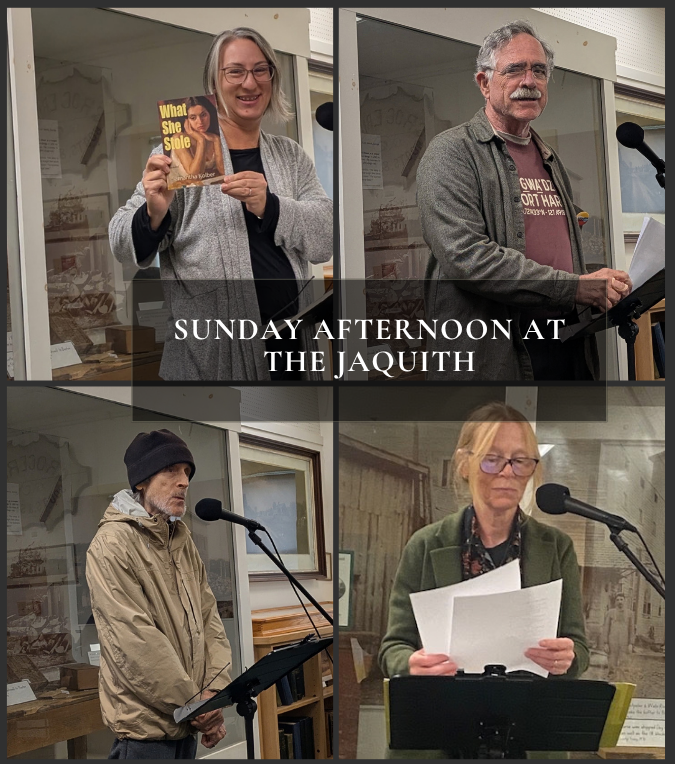
While autumn afternoons are always tough to compete with, those who gathered for September 20th’s Sunday Afternoon Poetry at the Jaquith were treated to an intimate, inspiring showcase of spoken word.
Our featured reader for the event was Samantha Kolber—an award-winning poet, piemaker, and the owner and publisher of Rootstock Publishing in Montpelier, Vermont. Samantha shared several moving poems alongside an essay connected to her debut novel, What She Stole, which releases this December in time for her 50th birthday.
Watch Samantha read one of her poems above!
Following Samantha’s set, poets daïthi’ (David Hartnett) and Elizabeth McCarthy each shared four to five original pieces. (Note: Scheduled reader Jannetta Lamout was missed but unable to attend.)
Catch daïthi’ performing one of his poems above!
To close out the afternoon, the floor was opened to audience members, featuring a reading by Poetry Society of Vermont (PSOV) member Neville Berle.
The October event at the Jaquith will be our last for the year so don’t miss out on Sunday Afternoon Poetry at the Jaquith October 18th 2pm – 4pm (a combined Art & Poetry Event with an Art Opening (2pm-3pm) with Frederick Rudi and Poetry readings (3pm – 4pm) by Scudder Parker and Judith Janoo.)
You can pre-order a signed copy of “What She Stole” online from Bear Pond Books. Be sure to support member authors by purchasing a copy of their book(s.) Also, look for member books in your local independent bookstore( if not available, suggest they support Vermont poets and stock them.)
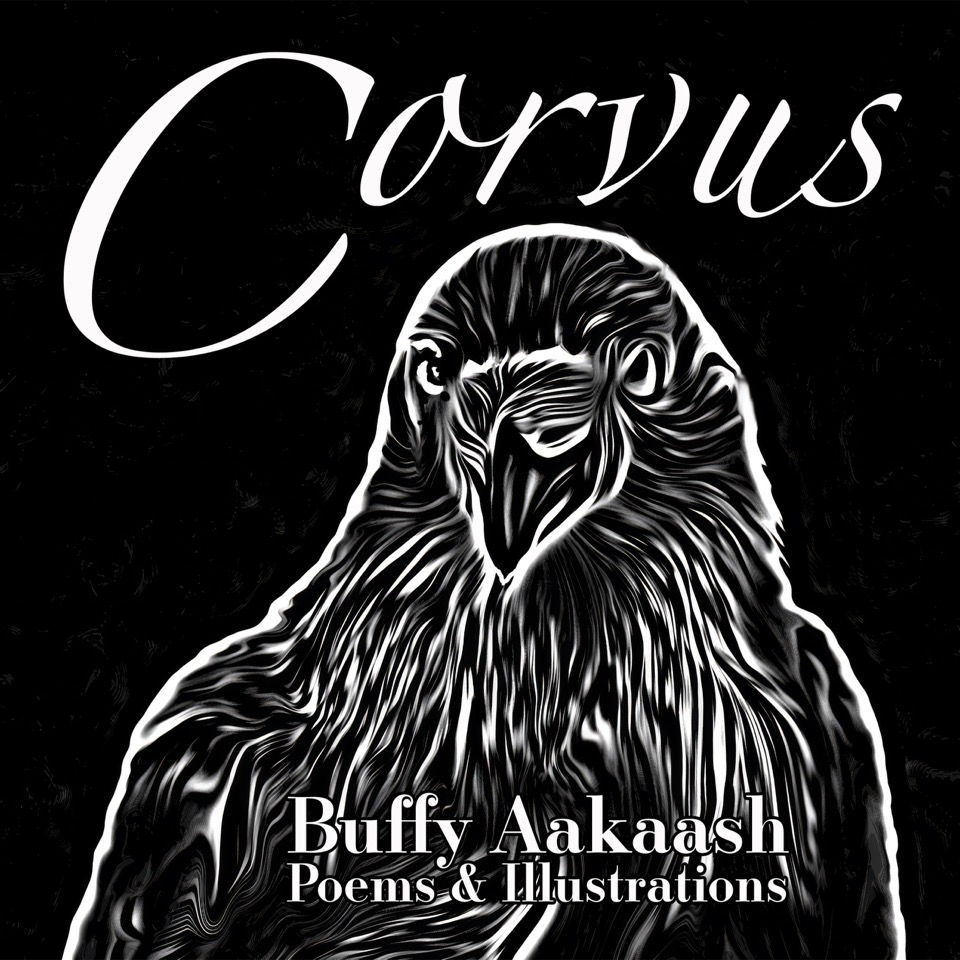
What I wish to share with you is how Corvus–Buffy’s newest publication– represents a unique approach to publishing. Then, I will tell you some other unique features of this book.
Many of us know that the publishing industry has changed in recent years–from wining and dining writers to having them do the heavy lifting. As a result, poets have chosen alternate routes–from printing broadsheets for local distribution to chapbooks paid for by individual authors with presses helping to put them in bookstores.
Corvus signals another departure from business as usual. Instead of waiting for a major publisher to find him or to pay an alternative press to crank out his book, Buffy has taken a different path. His approach might be called publication by subscription. By producing a small number of books–100 in this case–he is relying on 25 subscribers to cover the cost of production. Anything above that goes directly to him. There is no middle man. There is no Amazon.
While scrolling through the book and reading the poems out loud, other unique features became obvious. Twenty-seven poems were included in Corvus. Interspersed throughout the book are also 23 woodcut scenes of crows. Some alone. Some in pairs. Others bunched in trees. The artwork as well as the written work was done by Buffy. As was the page design.
Oh not again the corvid comes
Tells me to get over myself
Your world passes you by
with your eyes wide
(“Eyes Wide as Crows Fly” p.9)
For additional information about this amazing book, go to:


 A huge congratulations to our brilliant nominees.